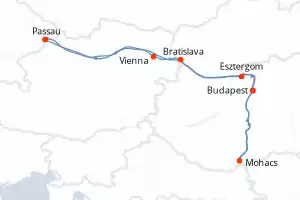
Budapest stages the river like a set piece. From Gellért Hill to Margaret Island, bridges connect Pest’s boulevards to Buda’s slopes; the Parliament, Buda Castle Quarter, and Andrássy’s axis read as one continuous waterfront composition. Upriver, the valley tightens into the Danube Bend. Szentendre sits first, an artists’ town with church spires and cobbled lanes above a calm quay. Visegrád follows at the narrowest part of the bend, its hilltop citadel and riverside palace terraces looking out over an S-curve of water and forest. Beyond, Esztergom’s basilica crowns a bluff with sweeping views across to Slovakia. Passing villages and ferry slips line both banks; wooded hills keep horizons low and green. Even without detours, the sequence—city panorama, islanded midstream reaches, then bend-hugging banks—delivers varied perspectives at an easy cadence. Late light pulls warm color onto limestone, copper, and the river’s passing surface; mornings hang pale and still. In between, you move from grand architecture to compact towns within a short run, with memorable vantage points from promenades, embankments, and hill paths close to the channel. Short ferries crisscross to low piers. The Danube’s character here is pictorial more than wild, favoring human-scaled scenes layered with history and constant water views.

 786 8400111